The Great Escape: Your Roadmap From Vendor Lock-in to Marketing Sovereignty
A presentation at TYPO3Con 2025 in in Düsseldorf, Germany by Ruth Cheesley

The Great Escape: Your roadmap from vendor lock-in to marketing sovereignty TYPO3Con 2025 - Düsseldorf @RCheesley
Ruth Cheesley (she/her) Mautic Project Lead & Co-Founder, Women of Open Source community ruth.cheesley@mau c.org speaking.ruthcheesley.co.uk for slides, recording, links and resources ti @RCheesley

My journey with open source marketing stacks.

Vendor lock-in: a risk to business

I’ve felt the pain and frustration.
Starting February 18th 2025, Klaviyo enforced its new ‘pro le compliance’ policy, automatically moving customers to a higher pricing plan if their active pro les exceeded a limit introduced on their plan [rather than billing based on the number of emails sent, which was the previous way of working]. Although the initial increase was capped at 25%, many predicted this is just the beginning, with full compliance expected to roll out later this year. fi fi Source: https://www.wedocrm.co/blog/klaviyos-latest-price-changes-what-it-means-and-how-to-adapt

In 2028, Adobe Experience Manager is sunsetting entirely their onpremise solution, forcing all users to move to their Cloud-based SaaS offering. This re ects a substantial price increase (in the tens of thousands ball park as a conservative estimate for most users) and a complete loss of control over customer data, necessitating re-platforming to another solution if customers want to retain ownership of their data. fl Source: https://experienceleague.adobe.com/en/docs/experience-manager-release-information/aemrelease-updates/update-releases-roadmap#aem-on-prem-managed-services
HubSpot’s custom report builder requires a paid Professional or Enterprise plan, as the feature is not available on the free tier. Many data sources such as emails, calls, meetings, notes, tasks etc associated with a company can’t be exported without it, and some types of data HubSpot cannot be exported at all. Source: https://knowledge.hubspot.com/reports/create-reports-with-the-custom-report-builder

Perhaps open source had the answers?

What components make up the marketing tech stack?
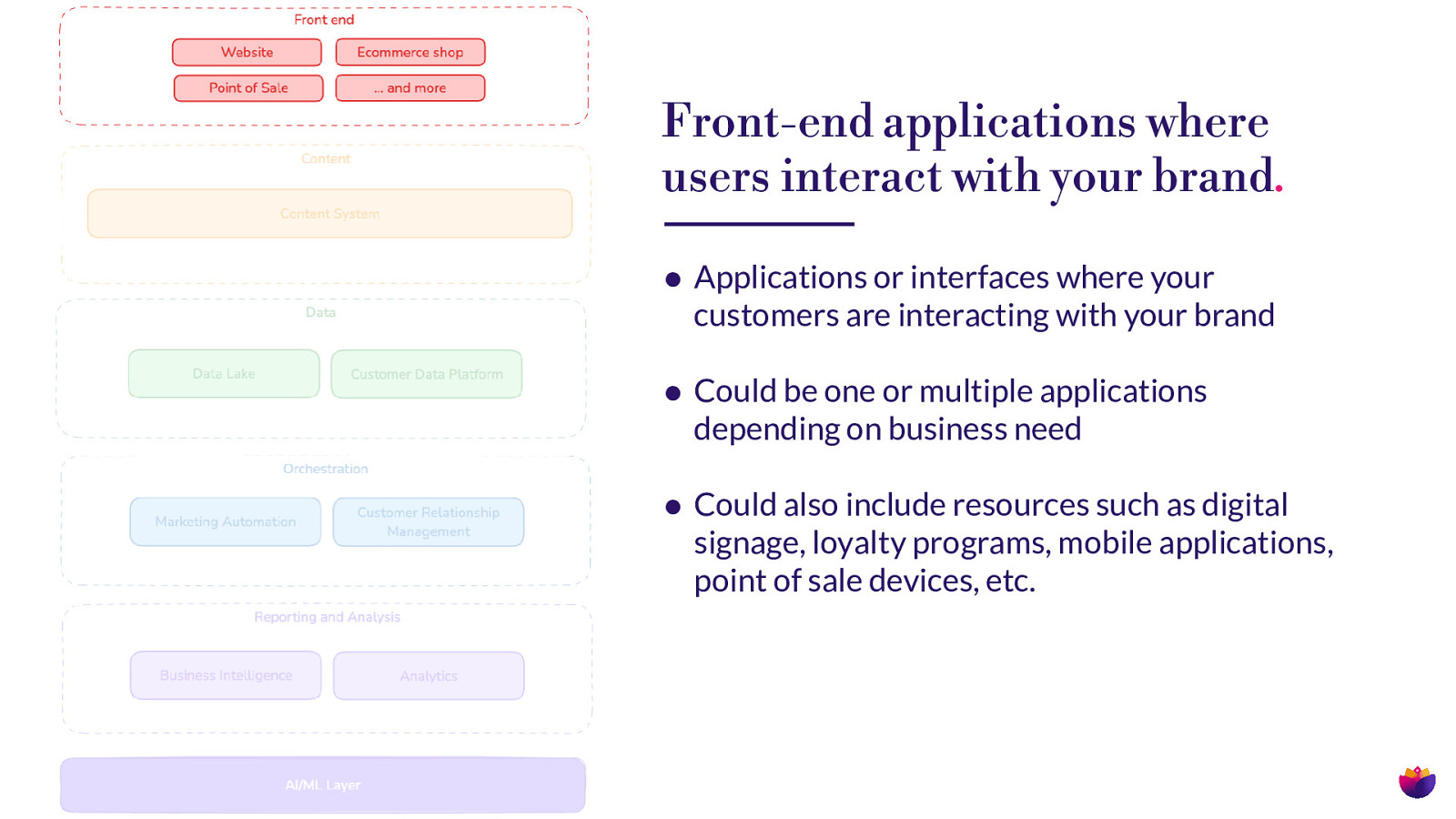
Front-end applications where users interact with your brand. • Applications or interfaces where your customers are interacting with your brand • Could be one or multiple applications depending on business need • Could also include resources such as digital signage, loyalty programs, mobile applications, point of sale devices, etc.
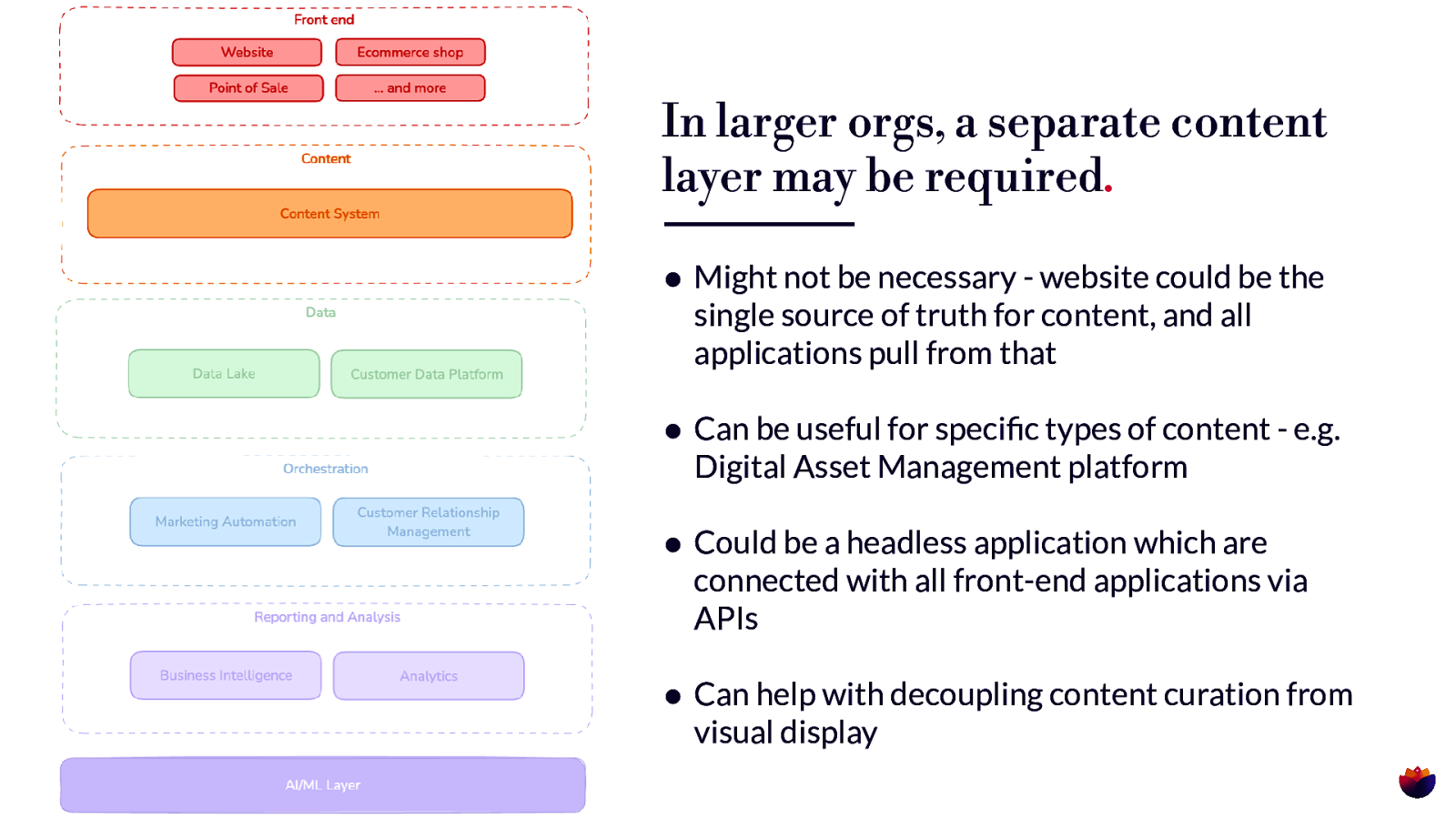
In larger orgs, a separate content layer may be required. • Might not be necessary - website could be the single source of truth for content, and all applications pull from that • Can be useful for speci c types of content - e.g. Digital Asset Management platform • Could be a headless application which are connected with all front-end applications via APIs • Can help with decoupling content curation from fi visual display
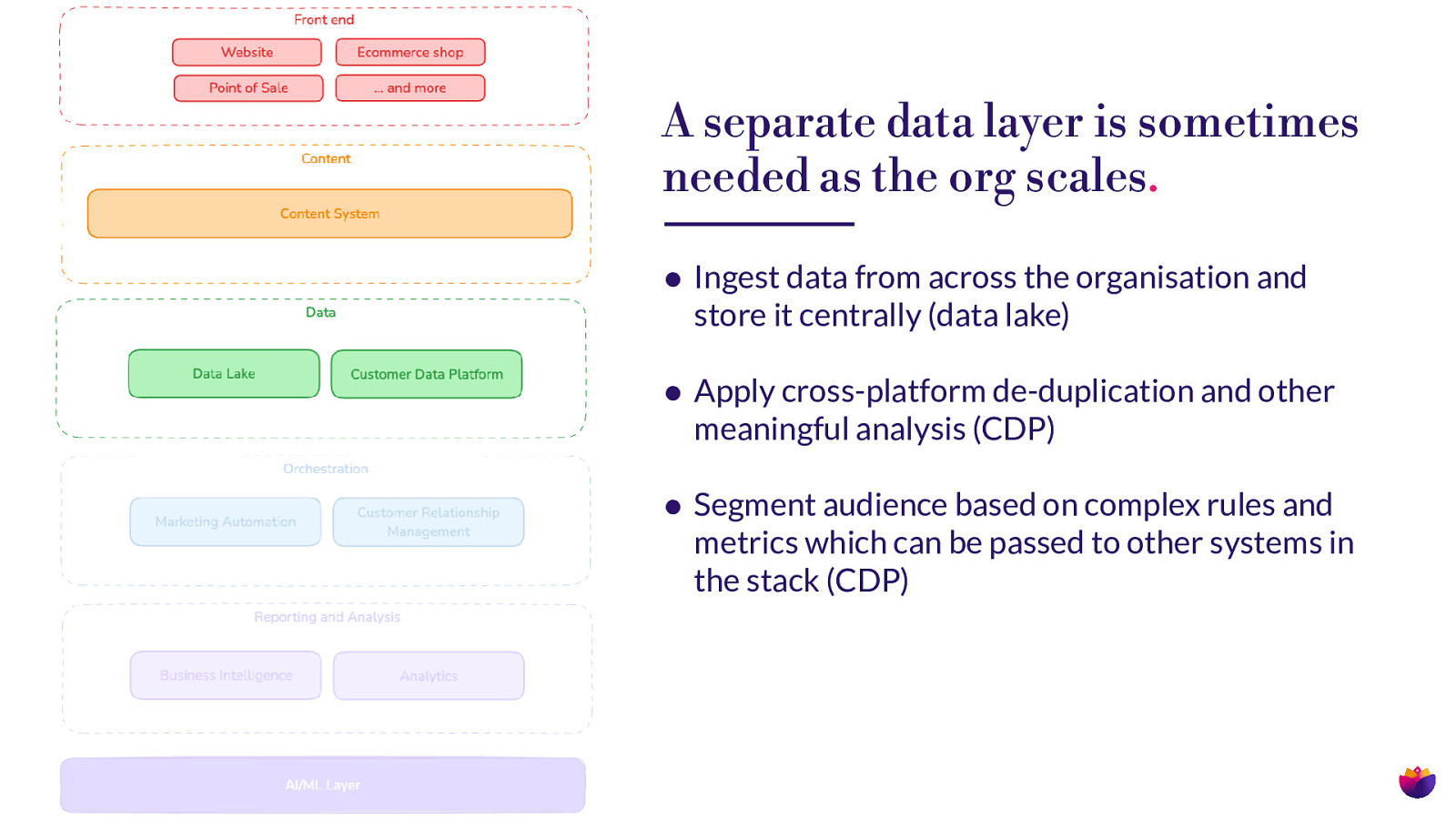
A separate data layer is sometimes needed as the org scales. • Ingest data from across the organisation and store it centrally (data lake) • Apply cross-platform de-duplication and other meaningful analysis (CDP) • Segment audience based on complex rules and metrics which can be passed to other systems in the stack (CDP)
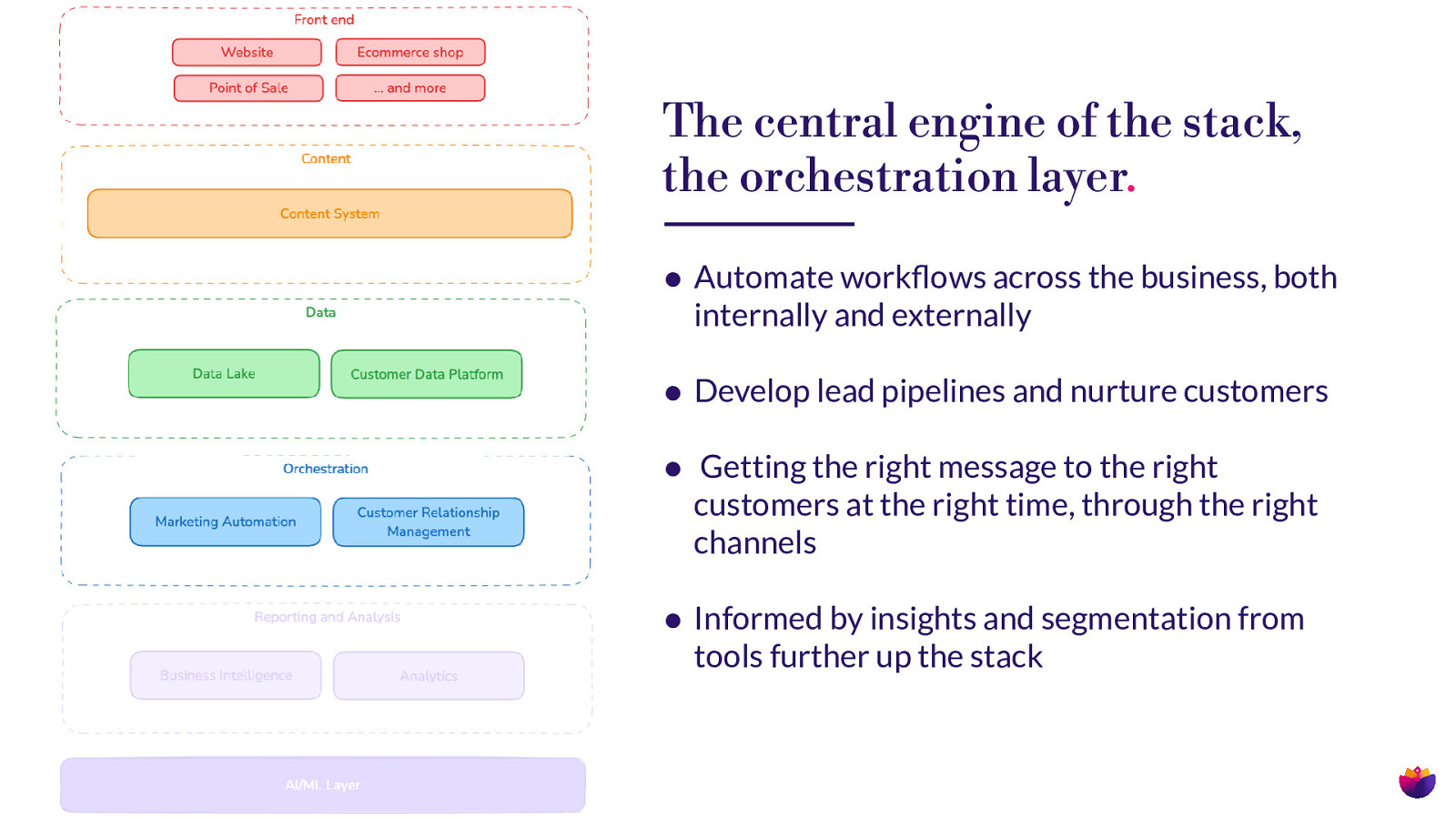
The central engine of the stack, the orchestration layer. • Automate work ows across the business, both internally and externally • Develop lead pipelines and nurture customers • Getting the right message to the right customers at the right time, through the right channels • Informed by insights and segmentation from fl tools further up the stack

Closing the loop with reporting and analysis. • Taking insights from the entire stack, the reporting layer enables full circle analysis of marketing campaigns • Can provide insights on internal processes as well as external communications, campaigns and interactions with customers
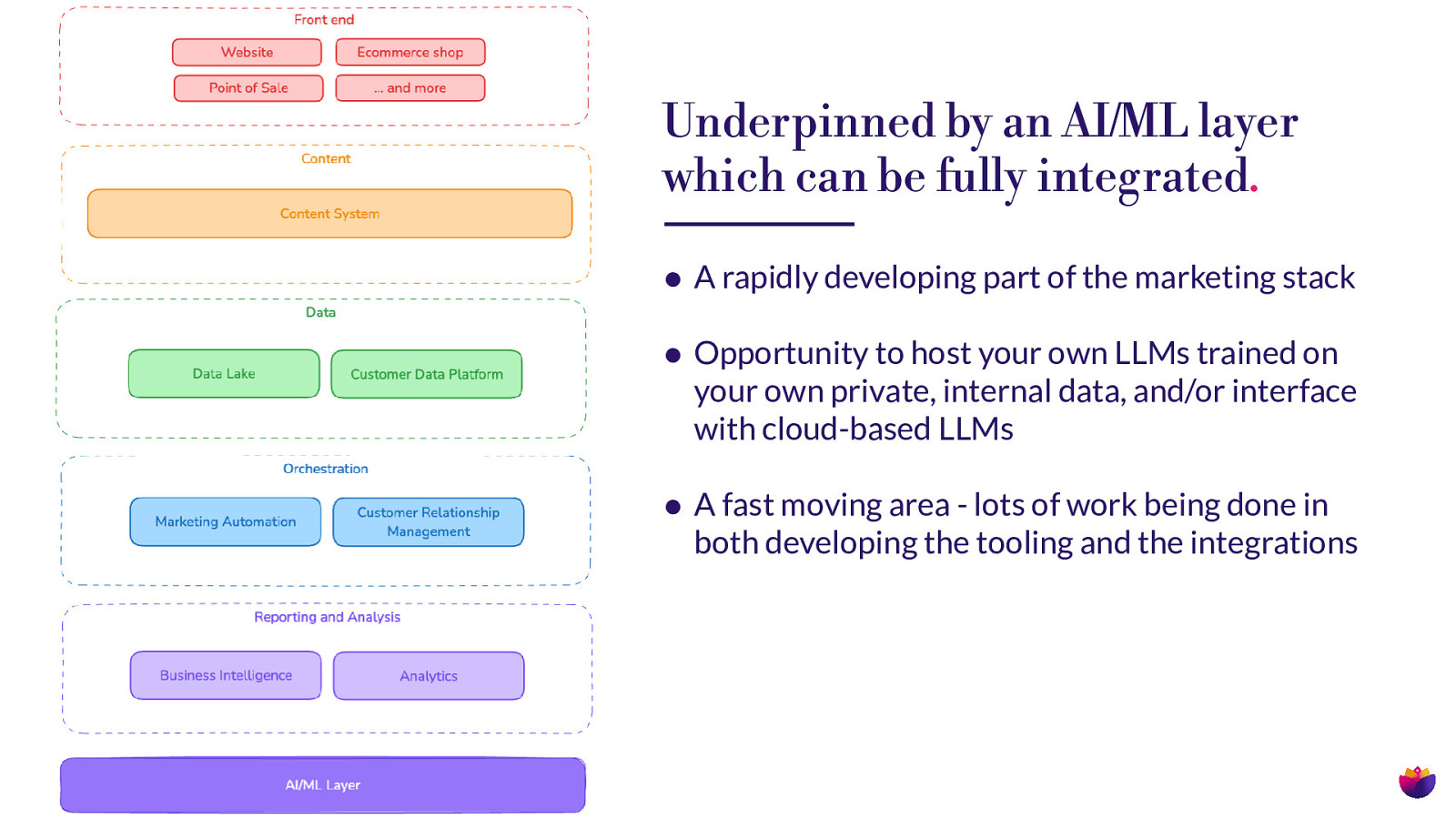
Underpinned by an AI/ML layer which can be fully integrated. • A rapidly developing part of the marketing stack • Opportunity to host your own LLMs trained on your own private, internal data, and/or interface with cloud-based LLMs • A fast moving area - lots of work being done in both developing the tooling and the integrations

There are multiple proprietary ‘all in one’ and thousands of ‘single product’ solutions out there. Start out as convenient but still locked in, costly, and reliant on their product roadmap.
There are awesome open source alternatives on the market for every part of the stack. There are many products and services that you can offer as alternatives.

Are you leaving money on the table?

Planning the Great Escape: the ‘safe house’

Getting started with a TYPO3 driven stack.

Driving engagement through targeted competitions.

Goal: plan the escape route, start digging the tunnels.
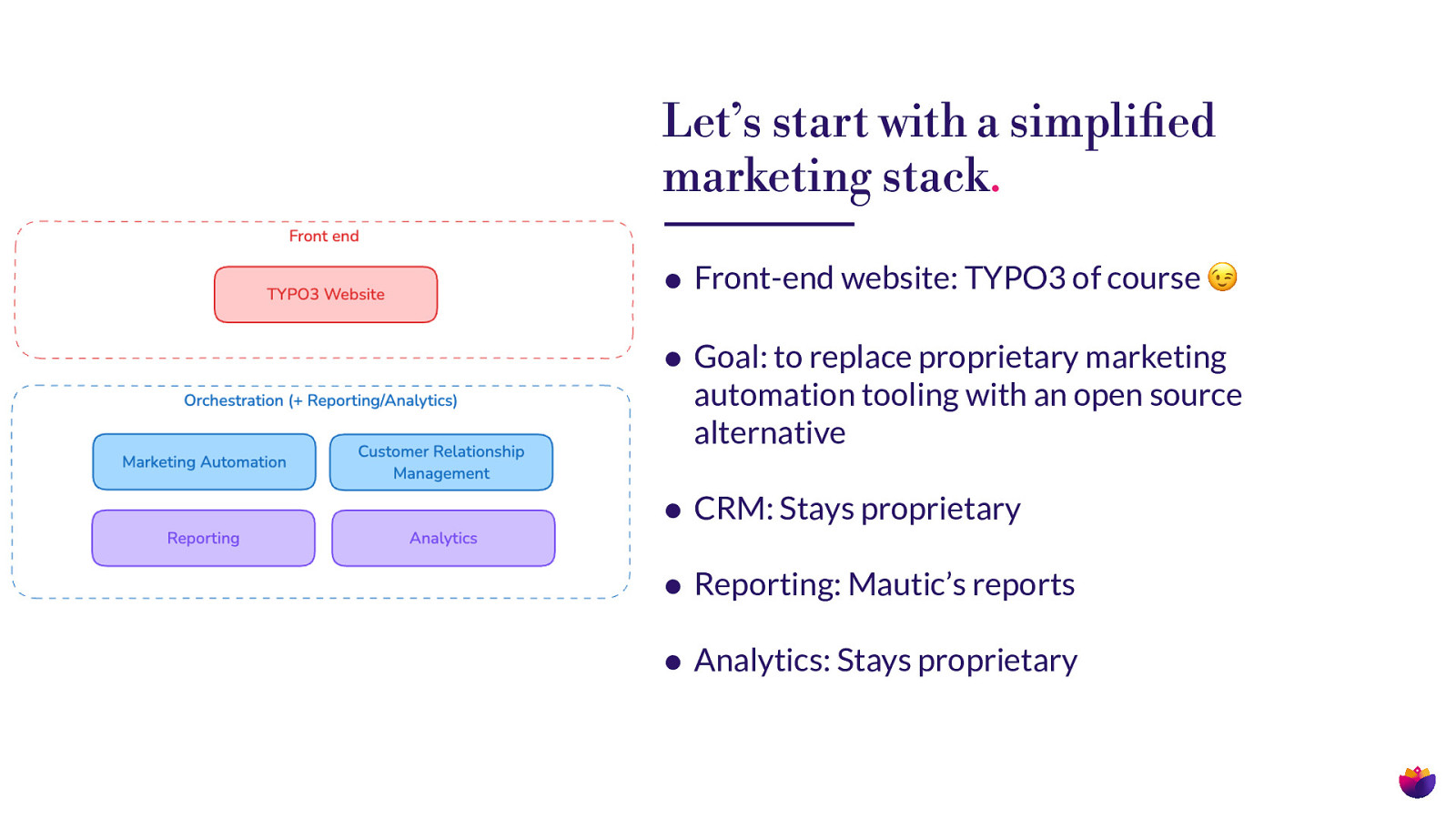
Let’s start with a simpli ed marketing stack. • Front-end website: TYPO3 of course 😉 • Goal: to replace proprietary marketing automation tooling with an open source alternative • CRM: Stays proprietary • Reporting: Mautic’s reports fi • Analytics: Stays proprietary
Digging our rst tunnel to deliver value and con dence. • For the next competition, instead of using a proprietary tool, we’re going to use Mautic. • We’ll need to create the work ows for this competition, but then we could easily roll it out to all competitions. Invest once, re-use. • We could also do more by exploring features like points, stages, segments, etc. • We could implement more advance features fl fi fi where appropriate - multilingual, A/B testing.
- Building the foundations Install Mautic and the TYPO3 Mautic connector. Implement the tracking script on your website (set consent mechanism correctly), connect TYPO3 forms with Mautic forms. Create form, embed on website or landing page. Connecting up the tools to enable seamless marketing automation and personalisation, all triggered from your website. Set up personas in TYPO3, allowing you to change the content on the website based on the visitor’s behaviour. This allows you to show different CTAs and content for different segments (e.g. enter your code v coupon off as thank you v upsell other products).
Set up nurturing campaigns in Mautic to drive engagement with the competition launch, using UTM tags to monitor engagement via web analytics.
- Building the foundations Install Mautic and the TYPO3 Mautic connector. Implement the tracking script on your website (set consent mechanism correctly), connect TYPO3 forms with Mautic forms. Create form, embed on website or landing page. Connecting up the tools to enable seamless marketing automation and personalisation, all triggered from your website. Set up personas in TYPO3, allowing you to change the content on the website based on the visitor’s behaviour. This allows you to show different CTAs and content for different segments (e.g. enter your code v coupon off as thank you v upsell other products).
Set up nurturing campaigns in Mautic to drive engagement with the competition launch, using UTM tags to monitor engagement via web analytics.
- Building the foundations Install Mautic and the TYPO3 Mautic connector. Implement the tracking script on your website (set consent mechanism correctly), connect TYPO3 forms with Mautic forms. Create form, embed on website or landing page. Connecting up the tools to enable seamless marketing automation and personalisation, all triggered from your website. Set up personas in TYPO3, allowing you to change the content on the website based on the visitor’s behaviour. This allows you to show different CTAs and content for different segments (e.g. enter your code v coupon off as thank you v upsell other products).
Set up nurturing campaigns in Mautic to drive engagement with the competition launch, using UTM tags to monitor engagement via web analytics.
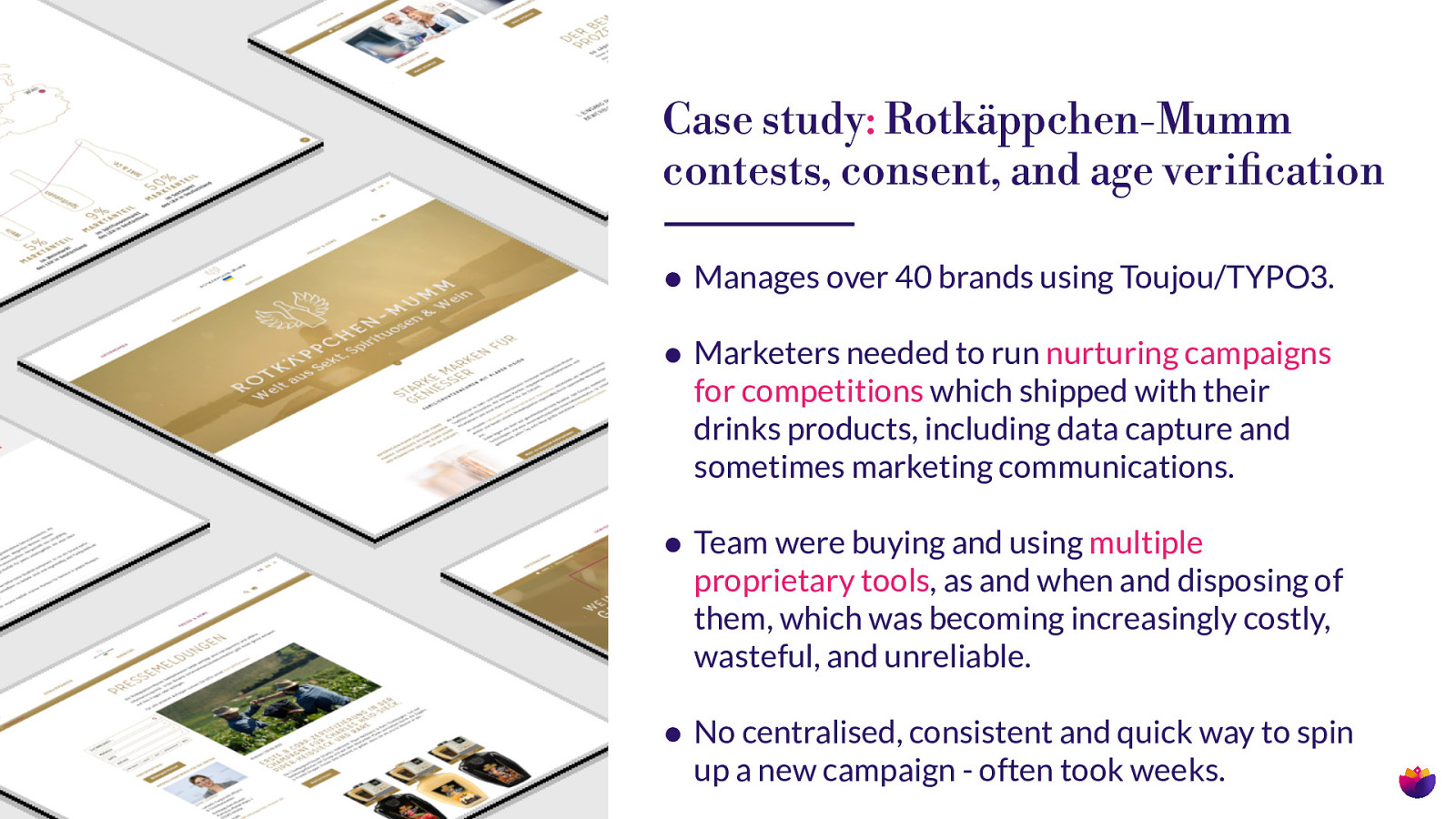
Case study: Rotkäppchen-Mumm contests, consent, and age veri cation • Manages over 40 brands using Toujou/TYPO3. • Marketers needed to run nurturing campaigns for competitions which shipped with their drinks products, including data capture and sometimes marketing communications. • Team were buying and using multiple proprietary tools, as and when and disposing of them, which was becoming increasingly costly, wasteful, and unreliable. • No centralised, consistent and quick way to spin fi up a new campaign - often took weeks.
Idea: What if we centralised this with an in house open source tool • Each brand manager and any agencies they worked with needed to have access only to their own resources, from one centralised instance managed by the company, and sometimes deployed at short notice. • Data needed to be exportable to verify purchases against POS data. • There needed to be a centralised age veri cation and consent process. fi fi • Mautic t the bill perfectly!
Outcome: A scalable solution for multi-brand competitions “By implementing Mautic, we transformed a complex, repetitive process into a scalable, ef cient solution that opens new possibilities and saves both time and costs. This has empowered our brands to engage more autonomously and effectively with their customers. fi Furthermore, through the expert use of TYPO3 and open source tools, our team ensured a solution free from proprietary lock-in, paving the way for sustained adaptability.”

Ruth Cheesley (she/her) What questions can I answer? ruth.cheesley@mau c.org speaking.ruthcheesley.co.uk for slides, recording, links and resources ti @RCheesley

While the open source community champions sovereignty across most technology domains, one remains largely colonised by proprietary vendors: the marketing stack. In this session we’ll explore the latest buzzword, the ‘Digital Experience Platform’, and how you can start to build one with open source. We’ll dive into what you can achieve with Mautic and TYPO3, and how to create a roadmap that enables your marketers to escape the clutches of their proprietary vendors in a sustainable way.
